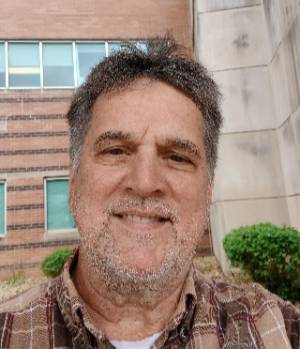
Dr. Robb Scott
Track: Unified Elementary and Special Education
Hometown: Council Grove, Kansas
Previous degrees: ED.D. in Special Education (K-State), M.A. in Curriculum & Instruction - TESL (KU), and B.A. in English (KU)
Why did you decide to pursue the Unified Elementary and Special Education Master of Arts in Teaching program at K-State: I saw K-State’s ad for this master’s in teaching K-6 Unified Special Education and general education licensure. It was a brand-new program. I served for six years on the Special Education Advisory Council that advised the Kansas Board of Education, so I was quite involved behind the scenes as the standards were being developed for this K-6 unified licensure program. I thought, you know, this looks interesting, exciting.
When TJ Duntz presented information about the program, he said that the state of Kansas needs elementary school teachers, especially special education teachers. I’ve trained a lot of teachers, but I’ve never had a teaching license in a public school. So, I thought now was the time.
What do you like about the Unified MAT program: It really pushes me to think. I’ve been in education, teaching and training teachers. I’ve been in this field for so long. This is such a wonderful opportunity for me to rethink things and examine my approach to teaching, hopefully becoming a better teacher.
The homework really pushes you to think and organize your ideas and understand what’s involved in planning, in teaching, in assessment and in classroom management.
What advice would you give to someone considering K-State’s MAT program: You’re not going to get a formula that will work perfectly every time. They’re going to give you practice thinking about different aspects of teaching and developing your own style. You’re going to have situations you’re not going to learn in class.
Each person develops their own style. You were in another field, and you’ve decided that you want to help in teaching. You feel called to it. What you’re bringing is not only your knowledge but also your approach, your philosophy and your desire to help.
How did your own experiences as a student shape the teacher you hope to become: My second-grade teacher at Norfolk Christian Grammar School, Mrs. Gallagher, talked to my parents. She was putting students together in small groups for reading and discussion activities, and I just seemed to be hesitant to talk. And there was a plot. My mom, my dad, my older brother, my sister and my younger brother were all in on it. At the supper table, a topic would come up, and they started this routine of one person saying, “What do you think, Robb?”
I was shocked the first time that happened. They waited, and then they waited some more. And then I started adding my comments, and that really worked. That was a teacher. It made a difference.
At K-State, I was introduced to Universal Design for Learning as a way to engage students. UDL makes it easier for everybody, all the students. For a few students, it makes it possible to access the curriculum; for everybody, it makes it easier. UDL has been baked into the program at K-State.