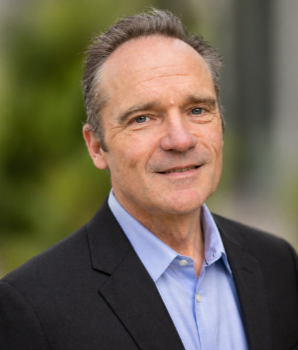
Thomas Vontz
Professor
Director, Master of Arts in Teaching and Center for Social Studies Education
While I was in college, I struggled figuring out what I wanted to do, like most college students. I eventually gravitated toward history and political science classes, and I enjoyed talking about those topics. The more I thought about it, the more I considered becoming a teacher, and now I’ve been at K-State for the last 20 years or so.
Before K-State, I was at a smaller university, and I heard through the grapevine about a job opening there. I wanted to be close to Lincoln, Nebraska, which is where I am from, but I also wanted to work at a larger university with more research and grant opportunities. So, I thought, “I’ll apply for a job at K-State.”
I ended up getting an interview, and then it just felt right when I arrived at K-State. It offered all the things that a big university offers, like research, scholarships and grants. However, it still felt like a small community where faculty were available and student-centered.
What led to the decision to create the MAT program?
The nice thing about being a faculty member is that you get to reinvent yourself every once in a while, and I’ve done that throughout my time at K-State. At my previous university, we worked on an in-person program for graduate students who did not have undergraduate degrees in education but wanted to become teachers. It became very successful.
Then, when I came to K-State, I mentioned several times that I wanted to create a similar program, but online. In 2015, my colleague, Dr. Larson, and I discussed the possibility with our department chair and the dean. That’s how the MAT was born at K-State.
A group of faculty members and I discussed how we could simplify the process of becoming a teacher for students who already have undergraduate degrees in another specialty. It shouldn’t be necessary to spend two or three extra years and earn another undergraduate degree to become a teacher. Often, people don’t know what they want to do when they’re 19 and earning a degree. With that market in mind, we designed a teaching pathway specifically for those who want a career change.
When we first launched the program, people said it would never work online. We only needed six people, but we ended up getting 39 in the first class. The MAT has been growing ever since that first year.
What classes do you teach in the program?
I teach EDCI 702, which is Curriculum, Instruction and Assessment. It is a required course for everyone in the MAT program. It’s one of two required prerequisite courses before they can take other elective or core courses. It just establishes a common vocabulary, a baseline of ideas, concepts and skills that teachers at all levels are familiar with.
We tend to stick to methods we know were important 100–1,000 years ago and remain important today and in the future. For example, asking really good questions, establishing very clear objectives, motivating other people intrinsically and extrinsically and making good judgments in teaching.
I also teach the capstone course EDCI 890, which is basically a portfolio course. Students know from the beginning that they have a final project. We help them put it together and show them how to put their best foot forward. Lastly, I teach EDCI 886, which is an orientation into teaching. It is like a teacher boot camp experience to get them ready for their first day, week and semester of teaching.
How would your students describe you as a teacher?
Most students say I am rigorous and have high expectations. They also say that my courses are practical. They would say that I treat students fairly and with respect. I hope they say I’m clear and that my instructions are clear. It’s one of the core teaching skills that I harp on a lot. Teachers have to be clear. They have to make complex ideas clear. In fact, my primary job as a teacher is to translate complex ideas and make them accessible to my students.
When I teach future teachers, I help them explore how teaching and education influence their world. Whatever we’re doing in my classes, we’re helping them perceive the classroom accurately, carefully analyze what’s going on, prudently make wise judgments about what they are going to do next and, hopefully, competently act in the classroom. So those are two key parts of my teaching philosophy.
What is your advice to incoming MAT students?
The most important piece of advice I can offer incoming MAT students is to allow themselves to grow. Becoming a great teacher takes time and experience. Cut yourself some slack. No one expects you to be perfect, and you shouldn't either.
Expect ambiguity in teaching. Answers are not black-and-white, yes-or-no, right-or-wrong. There are good and bad ways to proceed as a teacher. It’s their job to figure out what’s right in the context. Teaching is not following a script. Really good teaching is dynamic, it’s ever-changing, and it’s reacting and responding to different variables and contexts. It makes teaching challenging and rewarding. The fundamental teaching decisions are about gray areas.
Aristotle said that to live a good life is to find the golden balance, or harmony, among competing goods. Good teaching is that way too. We want to spark curiosity. We want to motivate students. We need to figure out how best to harmonize or balance those competing goods, given the context we find ourselves in.
I had a few veteran teachers who gave me some really good ideas for overcoming that fear. One of them told me to remember that teachers and parents are on the same team. We both want whatever’s best for the kid. I got to thinking about that, and it’s true.
Why should students choose the MAT program?
One of the most important aspects of the MAT is the culture we’ve established in the program. Over the past 10 years, faculty, staff and students have established our identity. I’m proud of that. We focus on helping every student become the very best teacher they possibly can.
From the time we first introduce ourselves to students in a webinar to the time that we say goodbye to them after they finish their portfolios, we make ourselves available to our students. We’ve established high expectations, being approachable and friendly, and providing every form of assistance we can to help them achieve their dream of becoming great teachers.